


Dharma and Karma are two fundamental concepts in Indian philosophy and spirituality, holding significant importance in religions such as Hinduism, Buddhism, Jainism, and Sikhism. These concepts are deeply interconnected, guiding an individual's actions, responsibilities, and spiritual journey in both personal and societal contexts "Dharma" and "Karma" are two foundational pillars in Indian philosophy and spirituality, holding immense significance in religions like Hinduism, Buddhism, Jainism, and Sikhism. These concepts are deeply intertwined, shaping an individual's actions, responsibilities, and spiritual journey in both personal and societal contexts.
Definition of DharmaThe term Dharma originates from the Sanskrit root "dhṛ," meaning "to uphold" or "to sustain." Dharma encompasses truth, morality, duty, ethics, and the righteous path of life.
Holistic Responsibility: Dharma includes personal, social, and spiritual responsibilities, adapting to an individual's caste, life stage, circumstances, and societal role (e.g., duties of a householder, king, or student).
Life’s Guiding Principle: It serves as a moral compass, balancing the four Purusharthas (goals of life): Artha (wealth), Kama (desire), Dharma (righteousness), and Moksha (liberation).
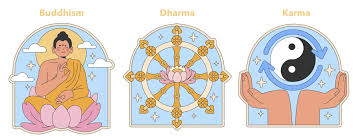
Definition of KarmaThe term Karma derives from the Sanskrit root "kṛ," meaning "action" or "deed." Karma refers to intentional actions—physical, mental, or verbal—performed by an individual.
Law of Cause and Effect: According to the doctrine of Karma, every action (Karma) produces a corresponding result (Karmaphala), which can be positive (Punya) or negative (Papa).
Beyond One Lifetime: Karma is not limited to the present life; it includes accumulated actions from past lives (Sanchita Karma) and influences future lives (Agami Karma).
The Relationship Between Dharma and KarmaDharma and Karma are mutually interdependent, each influencing the other in profound ways. Their relationship can be understood through the following key aspects:
a) Dharma Guides Karma
Dharma provides a framework for righteous action. When an individual aligns their Karma with Dharma, it becomes virtuous (Punya Karma), yielding positive outcomes.
For instance, in the Bhagavad Gita, Lord Krishna advises Arjuna to perform his Kshatriya Dharma (duty as a warrior) selflessly, emphasizing Nishkama Karma (action without attachment to results).
b) Karma Shapes the Outcome of Dharma
Actions performed within the framework of Dharma lead to positive results in an individual’s life, while actions against Dharma (Adharma) result in negative consequences.
For example, speaking the truth aligns with Dharma and generates positive Karma, whereas deceit leads to negative Karmaphala.
c) Dharma and Karma as the Path to Moksha
Performing Karma in accordance with Dharma purifies the soul, freeing it from the cycle of birth and death (Samsara) and leading toward Moksha (liberation).
The Bhagavad Gita emphasizes Nishkama Karma Yoga—selfless action performed in alignment with Dharma—as a means to attain Moksha.
Dharma refines the quality of Karma, enabling an individual to transcend the cycle of Karma and achieve spiritual liberation.
d) Personal and Social Context
Dharma outlines societal duties, such as those of a parent, teacher, or citizen, which are fulfilled through Karma.
For example, a parent’s Dharma to care for their family is actualized through Karma, such as providing support and nurturing.
Balancing Dharma and Karma
Moral Compass: Dharma serves as an ethical guide for Karma. Actions deviating from Dharma lead to Adharma, resulting in negative consequences.
Purification through Dharma: Karma is purified when performed in alignment with Dharma. Without Karma, Dharma remains a mere theoretical concept.
Example: Donating with a selfless intent (aligned with Dharma) generates Punya. However, donating for fame or recognition deviates from Dharma, diminishing its spiritual value.
Dharma and Karma in the Modern Context
In modern life, Dharma can be integrated with personal values, social ethics, and legal frameworks. For instance, environmental conservation can be seen as a form of modern Dharma.
Performing Karma in alignment with Dharma fosters personal peace, societal harmony, and spiritual growth.
Actions such as volunteering, ethical decision-making, or sustainable living reflect the principles of Dharma and Karma in today’s world.