


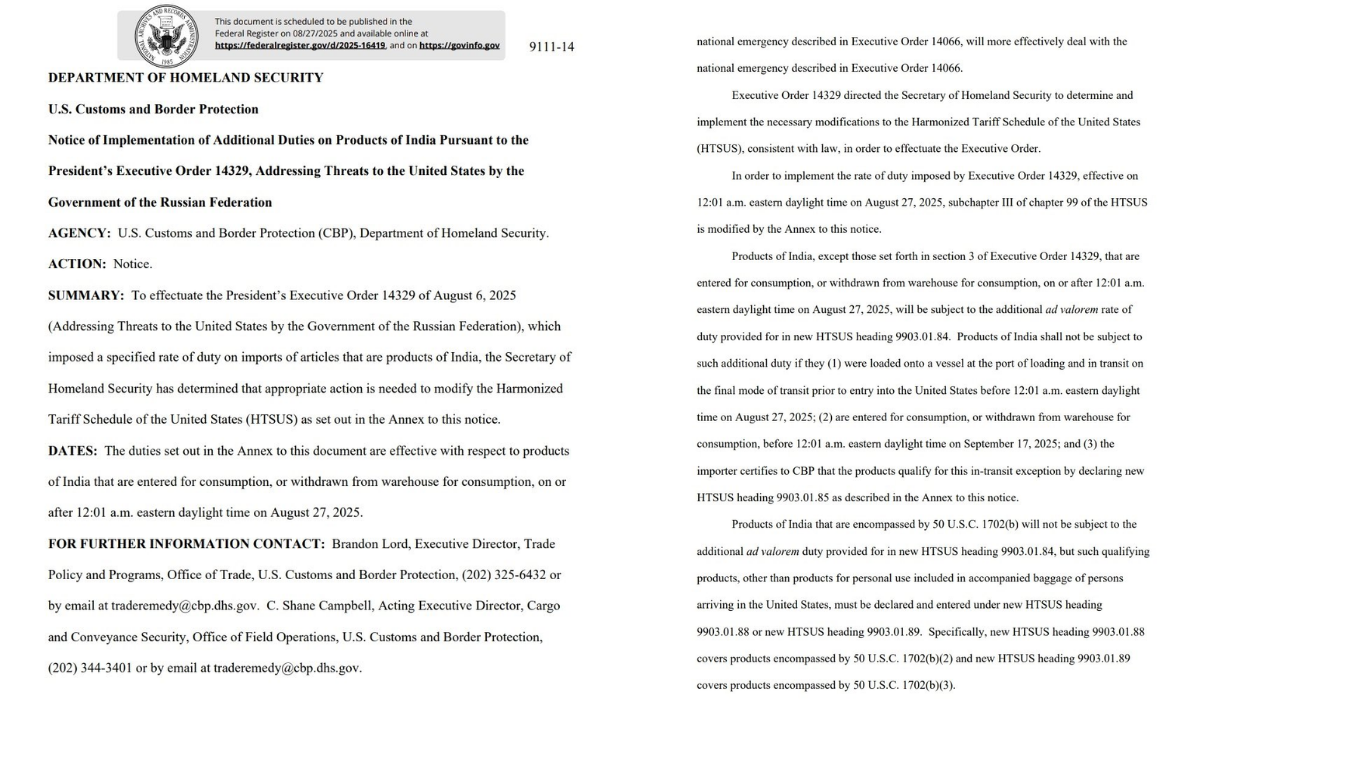
The U.S. Customs and Border Protection (CBP) has issued a notice implementing an additional 25% ad valorem duty on products imported from India, effective August 27, 2025, pursuant to Executive Order 14329, signed on August 6, 2025. This executive order, titled "Addressing Threats to the United States by the Government of the Russian Federation," cites India’s direct or indirect importation of Russian oil as a reason for the tariffs, claiming it contributes to Russia’s actions in Ukraine, which pose an "unusual and extraordinary threat" to U.S. national security and foreign policy.
Key Details of the Tariff Implementation:
Effective Date: The 25% additional duty applies to goods entered for consumption or withdrawn from warehouse for consumption on or after 12:01 a.m. EDT on August 27, 2025. Goods in transit before this date and entered before September 17, 2025, are exempt.
Scope: The tariff is in addition to existing duties, including a prior 25% reciprocal tariff imposed on India on August 7, 2025, under Executive Order 14326, resulting in a cumulative 50% tariff on most Indian goods.
Exemptions: Products subject to Section 232 of the Trade Expansion Act of 1962 (e.g., steel, aluminum, copper).
Goods listed in Annex II of Executive Order 14257 (e.g., certain pharmaceuticals, semiconductors, humanitarian donations).
Goods exempt under 50 U.S.C. 1702(b), such as informational materials or personal baggage.
Sectors Affected: Non-exempt sectors like gems and jewelry, apparel, textiles, chemicals, engineering goods, and leather products face significant impact. Exemptions for passenger vehicles, light trucks, and certain pharmaceuticals mitigate some effects.YUISI Sun Hat for Men Women, Breathable Summer Hat for Travel, Hiking, Gardening, Sun Hats for Men & Round Sun Cap for Hiking, Hats for Women Indoor Outdoor Activities
Purpose: The White House, through Trade Adviser Peter Navarro, frames the tariffs as a national security measure to counter India’s refusal to stop buying Russian oil, which allegedly fuels Russia’s actions in Ukraine.
Context and Controversy:
India’s Stance: India, the second-largest buyer of Russian oil (1.6 million barrels per day in 2025), defends its purchases, noting that the U.S. and G7 encouraged buying Russian oil under the G7 Oil Price Cap to stabilize markets. Indian officials, including PM Narendra Modi, have called the tariffs “unfair, unjustified, and unreasonable,” arguing that the U.S. and EU also import Russian goods like uranium and fertilizers.
Geopolitical Implications: The tariffs have strained U.S.-India relations, described as a “seismic shift” by analysts, potentially pushing India closer to Russia and China. India and Russia vowed to deepen trade ties on August 21, 2025, including boosting Indian exports to Russia and sending skilled workers to address Russian labor shortages.
Criticism:
Economic Impact: Estimates suggest a $23 billion hit to India’s GDP, with $8 billion in exports at immediate risk. Indian auto component suppliers and construction equipment sectors may face supply chain disruptions despite exemptions for finished vehicles.